
Open Science & Open Education Activities
SSH CENTRE worked to strengthen Open Science and Open Education practices across climate, energy and mobility research. Our activities focused on helping researchers, coordinators, and proposal writers embed openness into their daily work, project design, and Horizon Europe proposals. These efforts resulted in three key resources that translate Open Science principles into practical steps for real projects.
Open Social Science Online Course
This self-paced online course builds on our expert webinar and offers five hands-on modules that show how to apply Open Science and Open Education in climate, energy, and mobility research. It is designed for early‑career researchers, coordinators, and SSH/STEM teams who want to make their work more transparent, collaborative, and impactful.
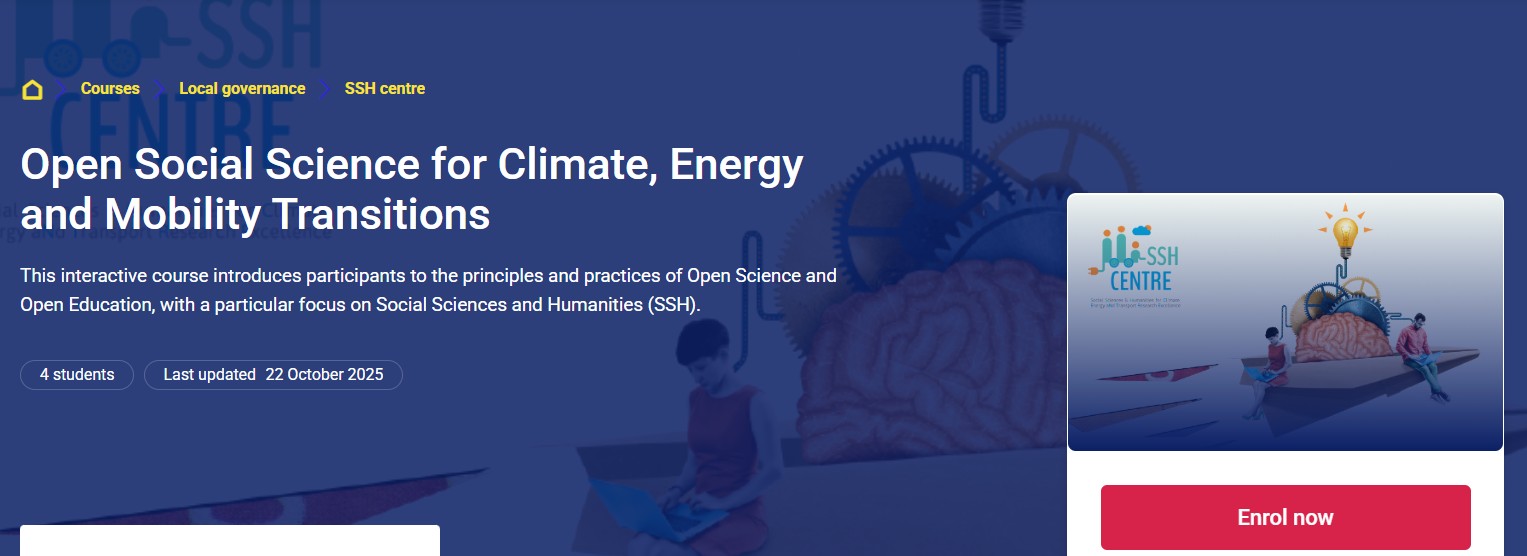
👉 Enroll in the course: https://localtransitionslearning.eu/enrol/index.php?id=71
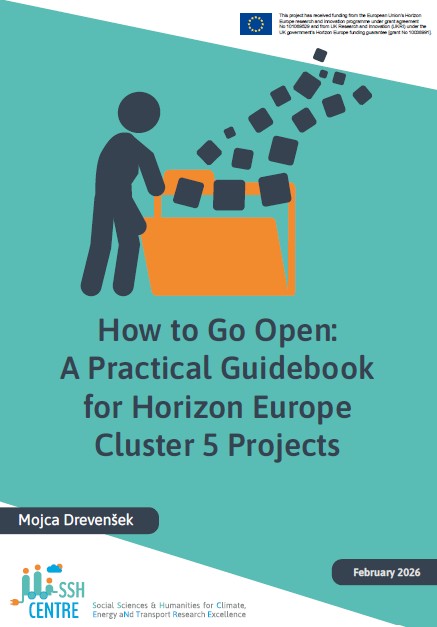
👉 Read the guidebook: https://sshcentre.eu/guidebook-open-horizon-europe-cluster-5/
How to Go Open – Digital Guidebook (Multilingual)
Our interactive guidebook helps Horizon Europe Cluster 5 projects integrate Open Science from day one. It includes step-by-step workflows, proposal recommendations, examples from SSH CENTRE’s own work, and infographics, videos, and expert insights. The guidebook is available in English, Spanish, Italian, Czech, Hungarian, Slovenian and German.
Open Social Science Webinar
This webinar brought together over 30 researchers and stakeholders to explore how openness can make SSH research more accessible, trusted and useful. The discussion laid the foundation for both the online course and the guidebook, offering real-world insights into how Open Science can support interdisciplinary collaboration.
Read the webinar blog post: https://sshcentre.eu/open-vibes-real-impact-a-look-back-at-our-ssh-webinar/

👉 Read the webinar blog post: https://sshcentre.eu/open-vibes-real-impact-a-look-back-at-our-ssh-webinar/
 This project has received funding from the European Union’s Horizon Europe research and innovation programme under grant agreement No 101069529 and from UK Research and Innovation (UKRI) under the UK government’s Horizon Europe funding guarantee [grant No 10038991].